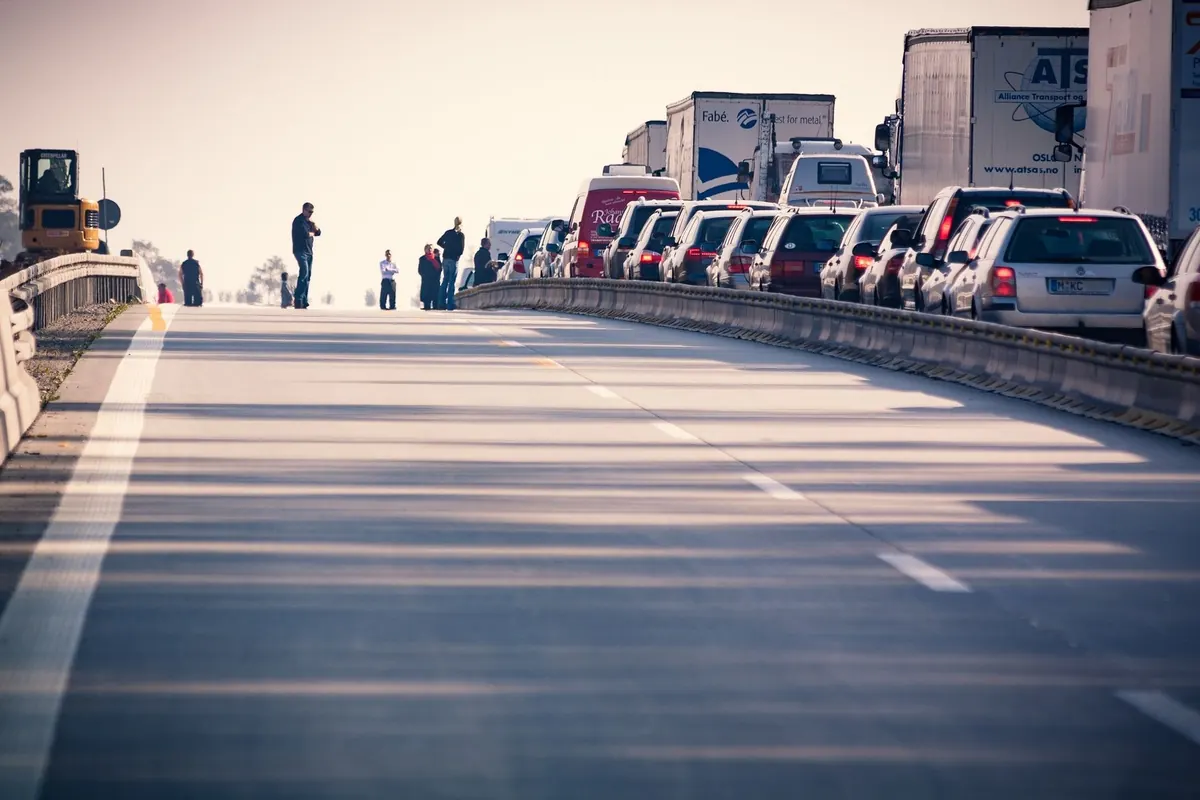
Holiday Travel Radar: How to Spot Peak Traffic Before You Leave
A long weekend looks simple from the sofa: pack the car, pick a time, drive. Then you meet the queue three junctions before the coast and watch an hour disappear. The annoying part is that the jam was visible hours earlier, in colour, creeping backwards across a live radar map. Holiday traffic isn't chaos. It has a rhythm, and radar shows that rhythm before you turn the key.
What follows is a working method, not a theory. It's the difference between hoping the road is clear and knowing roughly when it won't be.
Holiday Traffic Has a Rhythm You Can Learn
Commuter traffic spikes twice a day and settles. Holiday traffic behaves differently. It builds into one long, heavy surge as thousands of households make the same decision at roughly the same hour: leave after breakfast, leave after lunch, leave when the last shift finishes. Put that on a Friday before a public holiday, on a stretch of motorway everyone shares, and the surge becomes predictable in shape even if it isn't predictable in size.
The useful consequence is that you're rarely surprised by a holiday jam, only by where it starts. On an ordinary Tuesday, a forty-minute delay usually means a crash or a closure. On the Friday of a long weekend, it usually means volume: more cars arriving at a junction, a toll plaza or a tunnel mouth than the road can absorb. Radar shows that volume as slow-moving colour spreading backwards, which gives you something a route planner's single arrival estimate can't: a sense of how fast the problem is growing and which direction it's growing in.
Reading a Live Radar Map Without Overthinking It
Most live radar tools stack layers: flow, incidents, roadworks, weather. You don't need all of them at once, and you certainly don't need to study the whole country.
Start with flow, and look at the edges
Colour tells you speed relative to the limit, not absolute minutes. Green is flowing, amber is slowing, red is stop-start. The genuinely useful information sits at the boundary. Is the red patch spreading back towards your junction, or is the tail end lifting? A queue that has been shrinking for twenty minutes is a different animal from one that is still feeding itself.
Then add incidents and roadworks
A red stretch with a warning icon is a different problem from a red stretch without one. An incident may clear while you're driving; pure volume won't clear until the surge passes. Roadworks deserve extra caution on holiday weekends because they strip out capacity at exactly the moment demand peaks — and contraflow lanes have a habit of turning a slow journey into a stationary one.
Check the weather layer last
Rain doesn't just slow individual cars. It compresses the gaps between them, which turns a manageable queue into a stop-start crawl. If the radar shows a band of rain sitting over your route for the next few hours, assume the congestion will be worse than the colour suggests and plan the extra time.
A red line you can drive around is an inconvenience. A red line with no alternative is your whole afternoon.
Build Your Departure Around Windows, Not Clock Times
"We'll leave at nine" is a plan, but it's an incomplete one. What matters is which side of the surge you land on. There are two sensible strategies, and both work.
Get ahead of it. Leave early enough that you clear the first major junction before the volume arrives. That usually means being on the road while the radar is still mostly green along your corridor, even if it feels absurdly early. The reward isn't speed; it's predictability. An empty road absorbs small incidents without turning them into hour-long delays.
Or wait it out. Leave mid-afternoon, after the morning surge has drained, and accept that you'll arrive in the evening. This works well for shorter trips where the drive itself matters less than the arrival. It works badly if your route runs through a city ring road at the same time as a match, a festival or a holiday market — check the radar for local congestion as well as the long-distance corridor.
The strategy that fails most often is the middle: leaving "around the busiest time" because that's when everyone is ready. That's precisely when the radar turns red and stays red.
The Chokepoints That Eat Holiday Weekends
Congestion doesn't spread evenly. It gathers at places where capacity is fixed or temporarily reduced, then spills backwards. When you scan the radar, look for these first:
- Toll plazas and payment barriers. Even with electronic tolling, the lane discipline around a barrier compresses traffic. Expect the queue to start further back than the barrier itself.
- Bridges and tunnels. Fewer lanes, no exits, no alternatives. A problem here has nowhere to go, which is why tunnel queues can stretch for kilometres.
- Motorway interchanges and merges. Two busy flows joining at speed is a classic holiday pinch point, especially where a slip road is short.
- Service areas and fuel stops. Full car parks spill onto the approach road. If you need to stop, plan it away from the peak rather than joining a queue to enter.
- Coastal and mountain access roads. The last twenty kilometres before a popular destination are often single-carriageway and shared by everyone arriving at once.
- City ring roads on event days. A holiday weekend plus a fixture or a fair turns an ordinary ring road into a car park for two hours.
A Five-Minute Check Before You Start the Engine
Don't check once and commit. Run this short routine on the morning of departure and again shortly before you leave.
- Zoom out to the whole route first, so you can see the long red stretches rather than one local blob.
- Look at your corridor in the direction you're actually travelling — the opposite carriageway tells you nothing useful.
- Identify the first chokepoint and decide whether you'll reach it before or after the surge.
- Check incidents and roadworks separately from flow. Only one of them might clear.
- Find one realistic alternative for the worst section, and sanity-check it. A minor road with a level crossing isn't an alternative at peak times.
- Refresh the radar about twenty minutes before departure. Holiday jams change shape quickly in the first hours of a surge.
Coming Home Runs on Different Rules
The return trip catches people out because it looks like an ordinary drive. It usually isn't. The homeward surge tends to be sharper and later than the outbound one, concentrated into a narrow window on the final afternoon as everyone tries to squeeze a full last day out of the break. Sunday evening and the last public-holiday afternoon are the classic pinch points.
Two habits help. First, check the radar for the return leg the night before, not in the car with the engine running — you'll make a calmer decision about whether to leave early or stay for lunch. Second, remember that the calm map you saw on Friday morning says nothing about Sunday evening. Traffic patterns are directional and time-bound; a route that was clear outbound can be the worst part of the journey home.
Make It a Ritual
Checking live radar before a holiday drive takes about as long as making a cup of tea, and it changes the quality of the decision you're making. Not because it guarantees an empty road — it won't — but because it moves you from reacting to planning. You'll know which junction is likely to bite, whether your departure time sits on the right side of the surge, and what you'll do if the first plan falls apart.
Build the habit around three moments: the evening before, the morning of, and twenty minutes before departure. Then drive with your attention on the road rather than on the fear of what's ahead. If a route involves anything beyond ordinary driving risk, or you're travelling with passengers who need extra care, use your judgement and, where relevant, seek professional advice rather than relying on a map alone.
Photo: Pixabay / Pexels